The Service Evolution Continuum
Five depths a client relationship can have, and what moves when it deepens.

Photo by KLAUDIA ZU
Where does the long question already live?
Quarterly results and complying with regulation and standards come with their own rhythm: instruments, owners, deadlines, and organisations have become good at them.
How the relationship with your clients evolves, and what your organisation becomes along with it, has a horizon rather than a deadline. It is the question that decides whether the other two still matter in ten years.
Why look at a client relationship this way?
Two things are happening to your clients at once. Their world keeps getting more complex, so more of what they face arrives without a settled answer and the weighing of it becomes the harder part. And what used to take an expert now takes a search.
Imagine these situations:
A patient walks in with an AI analysis already printed out.
A client turns up having read everything findable about their own situation, and wants to know why yours differs.
A prospect challenges the accountant with the tax scenarios the software has already run.
The knowledge that used to justify the meeting now arrives before the meeting does. What clients come for is the part technology reaches least: interpretation, judgment in their situation, and the presence that turns advice into a decision they can carry.
The doctor becomes an interpretive guide. The lawyer becomes a strategic thinking partner. The accountant advises on what the numbers mean for the decision at hand.
Each of those examples describes a position in the relationship as much as it describes the work. An interpretive guide stands somewhere different from a supplier of results, and clients feel that difference well before anyone gives it a name.
The five depths below give those positions a name.Five depths a client relationship can have, and what moves when it deepens
What are the five depths?
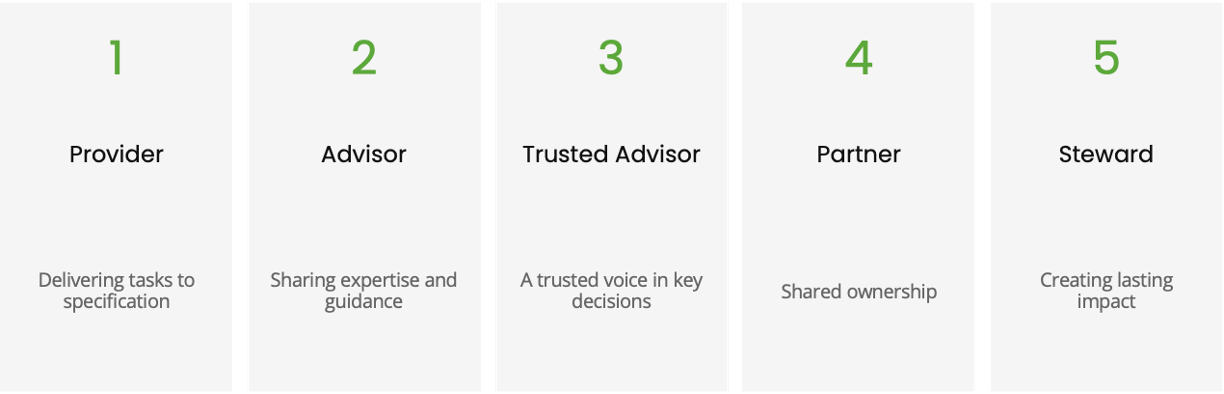
The Service Evolution Continuum
Provider
"Deliver this to our specification."
The work is defined, the service is executed well, and success shows up as efficiency and reliability.
Advisor
"We need your knowledge on this problem."
Expertise travels alongside the delivery, and the client weighs the advice and decides.
Trusted Advisor
"We trust your judgment on what matters to us."
You bring what you already have (expertise, and the judgment that has grown with it) and connect it to where the client is trying to go.
Partner
"Let's work out together what this could be."
The starting point is a question — an ambition or a challenge neither side can fully specify yet. Both invest, each on their own account, and both come out with more than they brought: new knowledge, a different way of working, and a share in what the work earns.
Steward
"Help us handle this, and make sure we can handle the next one ourselves."
The professional carries a complex transition and builds the client's own capability while doing it.
Between Trusted Advisor and Partner something changes in kind: in the one, value moves; in the other, it comes into being.
Is deeper always better?
No. Each of the five is a legitimate place to be, and clients are served well at every depth. A specialist who delivers precisely what was asked, on time, at a fair price is doing work that matters.
What counts is whether the depth matches what the relationship is asking for. A client who wants a Provider will find a Partner exhausting. A client carrying a real question will bring it to whoever has room for it.
Where do your clients place you?
Your own service is easiest to see from the inside: what you deliver, how well, at what cost. The more revealing view is the one from the other side of the table. What does this client think you are for, and what do they bring you?
That question usually opens the better conversation, because the answer sits in the relationship rather than in the offering.
What moves when a relationship deepens?
Three things move together.
The relationship itself: from executing a specification to sharing responsibility for what happens.
The focus of the service: from the deliverable, to what the client is trying to accomplish, to a question that has no answer yet.
The change capability inside your own organisation: deeper relationships ask more of how you work, decide, and carry uncertainty.
The third is easy to overlook, and it is what most of the movement depends on. Partner language is adopted faster than Partner capability is built. Naming that openly is what turns the ambition into something buildable.
What makes a deeper relationship possible?
Both sides, together. Every step asks each party to bring more into the open: what is still uncertain, how the work actually gets done, what they are accountable for beyond the task.
That is why the relationships that go deep usually trace back to a specific moment where one side went first, and it was met.
Where has a client already opened that door, and what became possible after it?
What does this mean for where you stand?
The deeper stages rest on exactly what the doctor, the lawyer and the accountant are now being asked for: interpretation, judgment in context, and trust built up across many exchanges. That is favourable ground for a mid-sized service organisation. They are large enough to hold genuine professional depth, and close enough to sustain relationships that go somewhere.
Three questions worth taking to your own team:
Where do our most important client relationships sit, and how would our clients answer that same question?
Which relationship is ready for a next step, and what would we be willing to share to take it?
What would that step ask of us internally, and how much of that do we already have?
This framework emerges from our ongoing research and practice with mid-sized service providers navigating the intersection of change leadership and service innovation. We continue exploring how organisations build integrated capability for meaningful impact while maintaining operational excellence.