What clients are asking of service providers, and how three principles work together

Where does the long question already live?
Quarterly results and complying with regulation and standards come with their own rhythm: instruments, owners, deadlines, and organisations have become good at them.
How the relationship with your clients evolves, and what your organisation becomes along with it, has a horizon rather than a deadline. It surfaces on a strategy day, in a conversation with a client of fifteen years, in something a young professional says about why they joined.
Those moments are fragments of the same thinking, and it is already happening across the organisation. What would it take to bring them together, and to have language that lets them be worked on?
What arrives in the room before you do?
Two things are happening to your clients at once. Their world keeps getting more complex, so more of what they face arrives without a settled answer and the weighing of it becomes the harder part. And what used to take an expert now takes a search.
A patient walks in with an AI analysis already printed out. A client turns up having read everything findable about their own situation, and wants to know why yours differs. A prospect challenges the accountant with the tax scenarios the software has already run.
The knowledge that used to justify the meeting now arrives before the meeting does. What clients come for is the part technology reaches least: interpretation, judgment in their situation, and the presence that turns advice into a decision they can carry.
The doctor becomes an interpretive guide. The lawyer becomes a strategic thinking partner. The accountant advises on what the numbers mean for the decision at hand.
This is usually felt long before it is named, and it is what gives the long question its weight.
What gives the long question a handle?
The question resists a single answer, because it can only be looked at from several directions at once.
Three of them come straight from what is changing in professional service. Technology has changed what the professional is there for. Clients now ask for relationships and outcomes that reach past the transaction. And the world around them values service that holds across time, stakeholders, and generations.
The three principles hold those directions open. Each turns the long question into something you can look at from where you already stand, in work your teams are already doing and in language they already use. Asked that way, it keeps its place alongside the quarterly rhythm rather than waiting for the next strategy day.
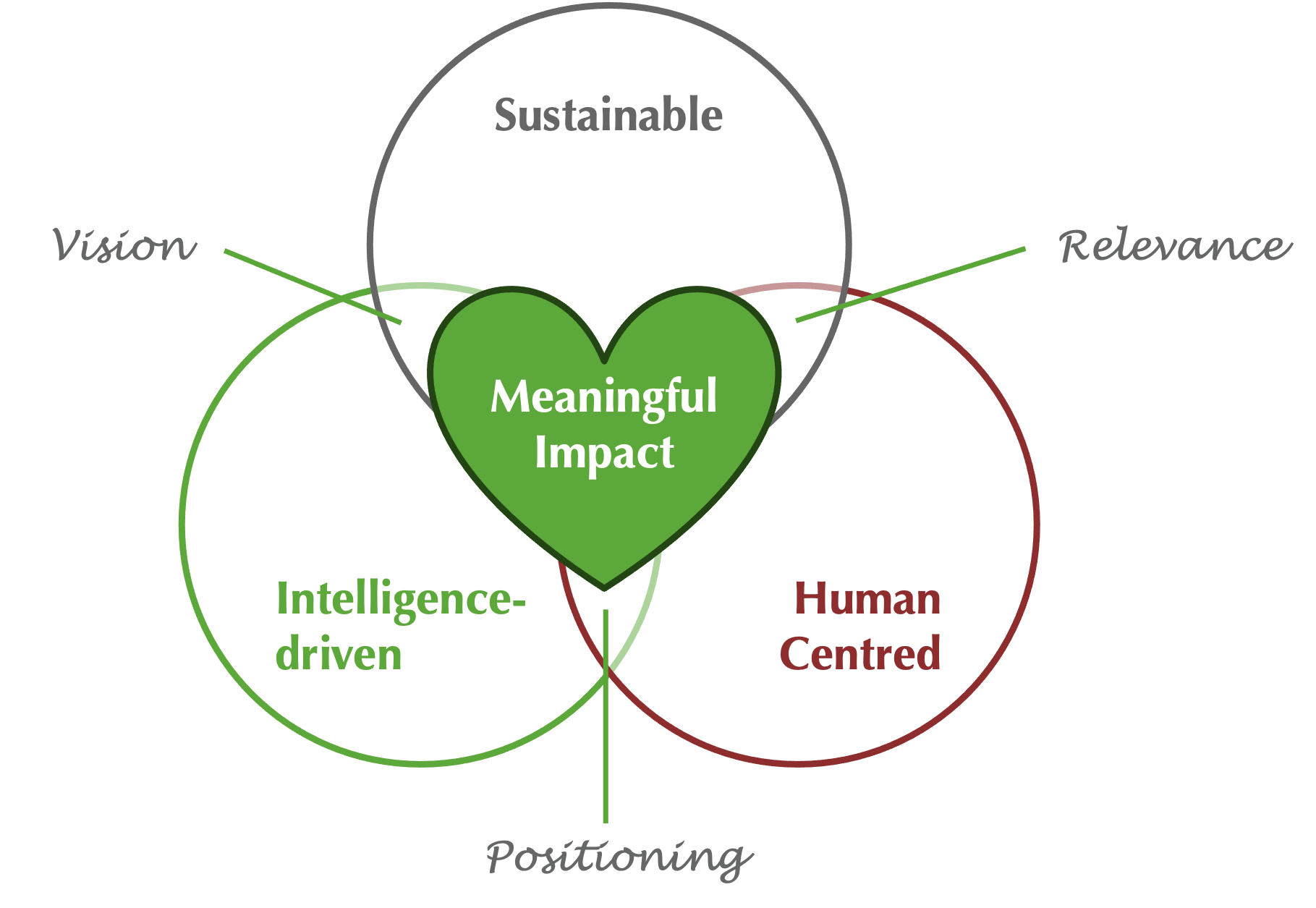
What does each principle actually ask of you?
Sustainable asks: does the value we create still hold in five years, and for everyone it touches? It works with five forms of capital at once — human, intellectual, social, environmental, financial — and asks whether they hold together.
Intelligence-Driven asks: where does technology give our people more room for what only they can do? Data reveals patterns intuition misses, and routine handling moves to the machine.
Human-Centered asks: what is this client actually trying to accomplish? The service takes its shape from that answer rather than from how the work is organised internally.
Sustainable gives the why, Intelligence-Driven gives the context, Human-Centered gives the core. In the organisations we work with, one has usually grown strong and the other two are where the next move sits.
What happens when one runs ahead of the others?
Strong on Sustainable alone, an organisation stewards an offering carefully while clients quietly draw less value from it.
Strong on Intelligence-Driven alone, it handles more, faster, and hears its clients less.
Strong on Human-Centered alone, it cares deeply, and meets the limits of what its capacity and time horizon allow.
Which of the three has the most room to grow in your organisation, and what would that open?
Where do outside and inside pull apart?
The vision comes from outside: clients, market, what society is starting to expect. The capacity to carry it is built inside: the organisation, its people, what they can hold. These move together, or the work stalls in a proposition nobody can deliver.
Where does the ambition on the outside run ahead of what the inside can carry today? And where does the inside already hold something the proposition has not caught up with?
Where do the three rub against each other?
They also pull against each other, and that is where the choices actually get made.
Automation frees the professional for interpretation, and automation taken further thins exactly what made the contact valuable: conversation becomes an intake form, judgment becomes a score. Where does that line run in your service?
A client asks for relief now; the longer view asks whether that relief defers a cost, to them or to someone else. Whose horizon are you serving when the two disagree?
Building intelligent capacity asks for real investment, and technology carries its own material cost. Which of your technology choices genuinely create value that holds?
Where this stirs something up in a conversation, all three principles are alive in the organisation.
What grows where they meet?
Three things become visible where the principles work together.
Value that lands and holds. Clients experience the service as useful in their situation, and that usefulness compounds as the relationship deepens.
Work people want to do. Professionals stay where the work is felt to matter, and engagement and retention follow.
Systems that regenerate. Client capability grows, community capacity grows, and the organisation itself gets stronger through the work rather than depleted by it.
What does this mean for where you stand?
Service relationships sit somewhere on a continuum: Provider, Advisor, Trusted Advisor, Partner, Steward. Each is a legitimate place to be. The deeper the relationship, the more it rests on what technology reaches least, and the three principles are what make the deeper stages workable rather than aspirational.
Three questions worth taking to your own team:
Which side is further along with us right now, the outside or the inside, and what does that ask of the other?
Which of the tensions above do we recognise most, and how do we currently resolve it, deliberately or by default?
What would our clients say we are for, and how far is that from where we would like to stand?
Framework for creating meaningful services through the integration of sustainable, data-driven, and human-centered approaches